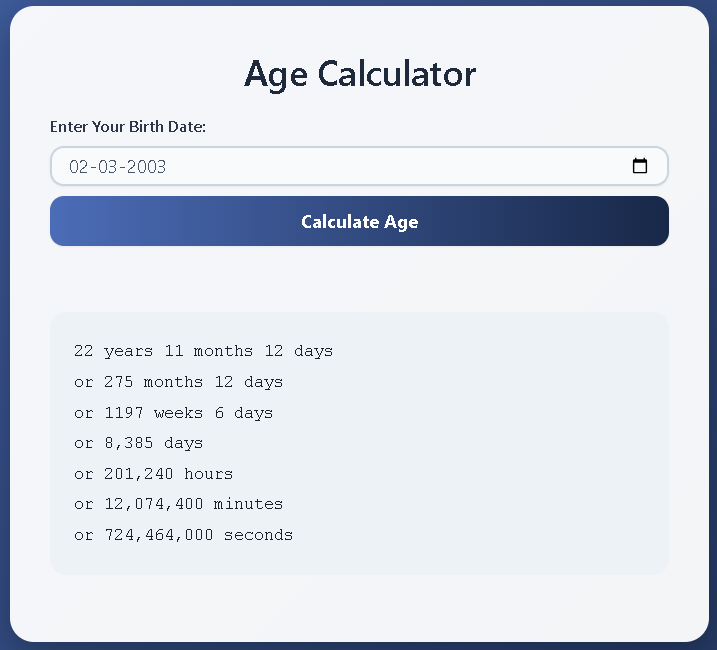
The Age Calculator can determine the age or interval between two dates. The calculated age will be displayed in years, months, weeks, days, hours, minutes, and seconds.
Age Calculator
How This Age Calculator Works: Understanding Different Age Systems
The way we count a person’s age is not universal. It varies significantly across different cultures and traditions. This calculator uses the most common international (Western) age system, which is the standard for legal, educational, and official purposes in most countries.
The Western Age System (Used by this Calculator)
In this system, a person’s age is zero at birth and increases by one year on each anniversary of their birth date—commonly known as their birthday. For example, a child who has lived for 3 years and 11 months is considered 3 years old. Only on their next birthday does their age officially become 4 years old. This method is precise, calendar-based, and widely adopted across Europe, the Americas, and many other parts of the world.
Other Cultural Age Systems
Not all cultures follow this approach. In some traditions, age is counted differently:
- Traditional Chinese Age System: A person is considered 1 year old at birth, reflecting the belief that life begins at conception. Age then increases not on the individual’s birthday, but on Chinese New Year. This means a baby born just one day before Chinese New Year would turn 2 years old two days later—even though they are only 2 days old in the Western sense [[1], [7]].
- Korean and East Asian Traditions: Similar systems exist in Korea and other parts of East Asia, where nominal age includes the time spent in the womb and may increment on New Year’s Day rather than the birthday.
These systems emphasize cultural values like respect for life from its earliest stages and alignment with lunar or agricultural calendars.
Handling Month-End Dates: Why Precision Matters
Calculating age between dates that fall at the end of months can sometimes lead to ambiguity due to the uneven lengths of months (e.g., February has 28/29 days, while April has 30).
For instance, consider the period from February 28, 2022, to March 31, 2022:
- One method treats February 28 to March 28 as one full month, leaving 3 extra days (March 29–31), resulting in 1 month and 3 days.
- Another method considers both February 28 and March 31 as “end-of-month” dates, treating the entire span as exactly 1 month.
Both interpretations are logically valid. However, this calculator follows the first method—counting complete calendar months from the birth date—because it aligns with the standard Western practice of anchoring age to the exact day of birth. This same logic applies to other edge cases like April 30 to May 31 or May 30 to June 30.